26 June 2014

History of Annabelle Hydrangea

Almost everyone has seen or has grown the Annabelle hydrangea (Hydrangea arborescens). So, I wanted to present something interesting for my featured plant - something most people do not know -- like "who was Annabelle?"

Obtained three years ago as a wee baby from the landscape architect friends, it was planted on the shady side of the back yard fence. I was filling in the areas along the fence. Having no plan or consideration, I take contributions of anything that grows. Normally my gardener's brain works backwards to most logical thinking: first get a plant, then find a place for it.

Our story begins in 1910 when Harriet Kirkpatrick was out horeseback riding along a wooded trail in the country outside Anna, Illinois. First, here's some interesting background on the family. Kirkpatrick Pottery was known for utilitarian and ceremonial presentation pottery (mostly ceramic pigs) throughout the 18th and 19th centuries. The family was wealthy so its could participate in activities like horseback riding. Pottery manufacturing was located where the clay and railroads were, and geologists reported that some of the finest clay was found in and around Anna, Illinois. Today the Kirkpatrick's Anna Pottery pieces have found their way to museums and collectors.

So wealthy Harriet was galloping through the woods, and noticed a wild hydrangea with large, more robust snowball-like blooms than the others. She summoned her sister-in-law Amy. "Have you ever seen a wild Hydrangea with snowball blooms?" So what would you do?

As we would have done, they scarfed it up and planted it in their garden. And also as we would have done, they proudly shared it with their neighbors and friends around town. 50 years later and growing 20 miles away (32 km) in an Urbana Illinois garden, it was brought to the attention of J.C. McDaniel, famous plantsman and professor of horticulture. Two years later after some nursery propagation and further investigation, it was introduced to the world. He first wanted to register the hydrangea as "Ballerina" (are ballerinas big and rotund?) but a name was selected to honor the belles of Anna who discovered it.

Its size and flower heads command attention and anchor one part of the back yard. Like dogwoods, the 'flowers' are actually flower bracts, which is probably why they last so long. I wrote this during the morning after an evening rain, and it reminded me of a known issue with Annabelle -- the tendency of the extra large heads to droop over, especially after collecting water.

Mother Nature did her own plant breeding to produce this hydrangea, easy to grow, large long lasting blooms, with few pests.

For The Record:
  • Heavy clay soil with gypsum
    & organic amendments
  • Mostly shade with morning sun
  • Small amount of fertilizer
  • No serious pests/disease


Garden Calendar:
  • Blooming: daisies, hydrangea,
    poppies, rudbeckia, echinacea,
    daylilies, bachelor buttons,
    hostas, cosmos
  • Harvested: green beans

31 May 2014

Cage Fightin' Strawberry

I bought strawberries at the grocery store. They were, well, strawberries. I picked my second pair of strawberries from the garden this week. They were phenomenal.

I scooped up the plant at our plant swap two years ago from a neighbor that was giving up on growing strawberries. "Too may critters and not enough rewards," was his answer. During the first year, the handful of berries produced went straight to bellies of squirrels, birds, and slugs, most while still an unripe white. The berries cropped up, off and on, throughout the year, although never as abundantly as in spring.

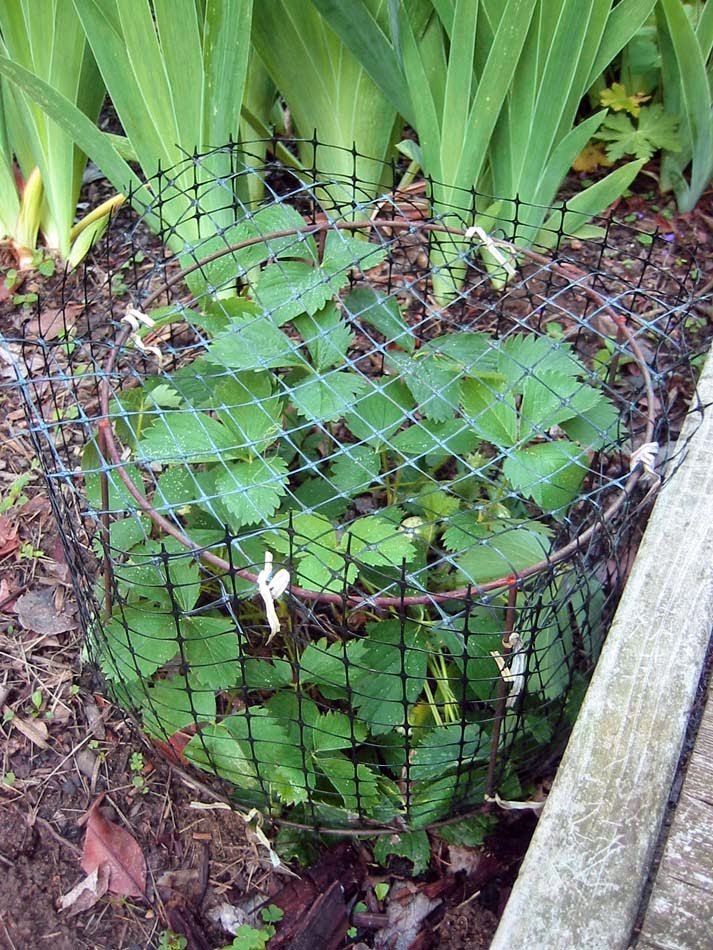
This year, the gloves gave off. I fashioned a small cage to keep the varmints out, and to date it is working. The top of a tomato cage is wrapped in bird netting, producing a netted top hat that is easily lifted to get inside. Squirrels can still reach into the berries if needed, but I believe they have not discovered the plant this year. If they show up in the ring, I will just build a bigger cage.

The berries were not large. For the taste test, I chomped into a mega-sized store-bought berry from California just before the home grown ones. The store-bought were fine. My home-grown berries taste 'noisy' -- screaming wild and strong. If only the berries were more plentiful and larger I would be singing, too. Even a small number of strawberries taste good with a scoop of vanilla ice cream.

For The Record:
  • Decent well-drained soil on a slope
  • Full sun, leaf mulch
  • Light amount of nitrogen fertilizer
  • Yellowing of lower leaves, squirrels and birds eat fruit


Garden Calendar:
  • Blooming: salvia, echinacea, coreopsis
  • Harvested: strawberries, spinach

22 May 2014

Stars For A Dark Garden

I dropped off cardoon and cannas to a fellow gardener. He asked if I would want some colocasia in return since I provided him suggestions on storing them over winter. I was asked to point out anything else that might interest me.

I spied the white flower stalks in the semi-shady area and pointed. "Those? You want some of those? What are they?" I didn't know either, except that I had to have some. They had tall daffodil foliage, growing in some shade, were 3-4 feet tall (1m), and had presence. Most likely a spring blooming bulb I thought, and asked to get some after the foliage died down later.

Next week, I was told to come and get 'em -- before the foliage had died down. They were dug up and left on his front porch. I stopped in and planted them that day as best I could, and crossed my fingers that they would replenish themselves enough to bloom this year.

I found the name is Camassia (Camassia leichtlinii spp. leichtlinii), and informed him. Camassia was usually blue, but this subspecies is white. Camassia is a native spring bloomer from the Pacific northwest down to the western Rockies. The bulbs were an important food source for native Americans and were roasted or boiled. Lewis and Clark wrote about eating them ... and about the severe gas cramps the men got afterwards.

Camassia does best in sun or part shade, and is found in meadows or near ponds. They will grow in damp areas other bulbs will not. (And they bloom during the late spring 'dead zone' when not much else does.) They should make great cut flowers, and the white subspecies can reseed easily, producing lots of offspring according to the Pacific Bulb Society. 'Marshy areas' and 'growing well in some shade' sounds great to help fill in my plant graveyard.

My Camassia came up this spring with thin spindly leaves. Bud stalks arrived later and are blooming. Did the lousy shady area with wet heavy soil or the transplanting before the bulbs redeveloped last year cause the small blooms? Or, maybe it was both. Because some of the bulbs did not produce flowers this year, the suspicion is that low development from last year was the culprit.

"Camassia prefer to grow undisturbed," say instructions. After this year, they will be moved to an area that gets slightly more sun. I look forward to next spring when more delicate looking white stars brighten up the shady spot between the hydrangea and polygonatum.

For The Record:
  • Heavy clay soil with recent organic amendments
  • Mostly light amount of fertilizer
  • Somewhat damp low-lying area
  • No serious pests/disease

Garden Calendar:
  • Blooming: salvia, coreopsis, tradescantia, camassia, dutch iris
  • Harvested: 1 radish

15 May 2014

May 2014 Bloom Day

Garden Bloggers' Bloom Day
What's blooming in the garden on the 15th of the month.

A few blooms, as that is all I have -- few blooms, unless someone wants to see green beans blooming.
First a gaggle of iris, and a matching gaggle of coreopsis. I just found the name (I think) of this purple one. See the previous post.


Iris germanica 'Fantasy land'
Coreopsis auriculata 'Nana'

Ready for their closeups, the geraniums really came on strong this year. They look great close up, but until this year, were too sparse and got lost in the garden. Dutch iris are just beginning.


Iris hollandica 'Discovery'
Geranium macrorrhizum 'Bevan's variety'

Staking the stalks on Invitation iris. I wish they could stand on their own two feet (or one.) Camassia is a first for me this year.


Iris germanica 'Invitation'
Camassia leichtlinii spp. leichtlinii


Rhododendrons also took off this year. I think they heard me talking about trimming them back, and responded. "Don't cut me back, bro. I promise to do better next year."

Rhododendron 'roseum elegans'

And a final composition with the Walmart iris ('Clarence') and the geranium on the side yard.

You can find other garden bloggers' May bloom days at the blog May Dreams Gardens.

11 May 2014

Garden Goddess Iris

The bearded iris (Iris germanica) are now the queens of the garden. This is the 'dead zone' time of year between perennials and spring bulbs when very little is going on. In May, the bearded iris shine above all else.

Iris comes from the Greek word for rainbow. In Greek mythology, the goddess Iris of the rainbow bore messages between the heavens and the earth. And iris are found in almost every color of the rainbow, but true red has eluded the growers. There are about 300 species of iris native to every continent in the temperate northern hemisphere, but are most prevalent in Europe and the Mediterranean. Because they are easy to cross and breed, there are about 40,000 introduced iris varieties.

The iris has six petals on its flower, although it appears to have three similar ones. It is a great example of a plant developed for pollinators, with a landing pad for flying insects. The entering insect hits the stigma first, depositing its pollen if any. Then, "backing out of the flower" it comes into contact with the plant's pollen, (after contacting the stigma) and can take it to the next flower. I don't think pollinators actually follow these rules someone thought up -- they just barge in and grab any pollen they can.

Iris have a place in human history. They have been around for centuries, and their symbols appear in ancient Egyptian tombs. The French Crusades brought them back to Europe from Syria, and they were adopted as the famous symbol of the French monarch, the Fleur-de-lis.

Frank Adams
Clarence
The Orris root (bearded iris rhizomes) were used for perfumes starting with the Egyptians, who burned them to create scent offerings to the gods. Clothes were boiled with iris rhizomes to perfume undergarments to mask body odors from at least the 1400s. Bathing was considered unhealthy.

Two of my iris have partial shade during the day but are doing very well. "How-to" articles say they do best in full sun and well drained soil. Their maintenance list includes dividing about every three years, more than some of my other perennials, and most of my friends run away now when they see me coming with bags of rhizomes. (If you want any Fantasy Land, drop me a line.) They don't make a good cut flower with each bloom lasting a day or two, and some stink.

Invitation
Fantasy Land
The Historic Iris Preservation Society aims to preserve old iris varieties, and has a huge collection of reference materials to identify and track down old varieties. Some varieties documented in old documents are thought to be lost, however, people believe they still exist in someone's garden somewhere and will be found.

The history of the American Iris Society is fascinating (to plant geeks and history buffs.) It was founded around 1920 because of confusion (and probably deceit) about varieties -- companies selling varieties after renaming them, developing varieties that someone else did, not documenting parentage.

Quaker Lady
In doing the research for this blog post, I believe the identities of the unnamed bearded iris in my yard are now found. Thank you HIPS for your online photo gallery. I swear all iris in the world are here in one gallery or another.

Frank Adams is the spitting image of the one I got at a neighborhood plant swap. It is the tallest, broadest (taking up the most space) and very prolific.

Quaker Lady, growing in the yard when the house was purchased, is certainly an older variety. It is short with smallish flowers and petals that slant outward.

Fantasy Land seems like a match to what I was calling Grape Nehi, although there are no sources on the internet where I can verify this one. It is most prolific and is found in several yards throughout the neighborhood.

Clarence was purchased at Walmart a few years ago - after seeing it in an iris catalog.

Invitation was a gift from the landscape architects who hate bicolor iris, and has stalks that always need to be staked.

Garden Calendar:
  • Blooming: azalea, rhododendron, ajuga, wood phlox, iris, allium, salvia

02 May 2014

The Deadbud And Friends

The winter damage to the garden is now coming into focus. The Chinese Redbud (Cercis chinensis) is now a 'red dud.' This is the most difficult loss. About fifteen years ago, I received a handful of Chinese Redbud seeds from the National Arboretum, as did other volunteers there. One the arboretum's heads went on a plant gathering expedition to China and came back with some material.

Pineapple Sage
Three of the seeds germinated. One was ripped up the following year, being mistaken for a weed. Another was probably run over by a mower. The third survivor, however, did not grow much over the years.

Three years ago, I made a real effort to improve its soil and encourage its growth and development. It responded, growing new branches and reaching about 7 feet tall (2m) last year. Every spring I looked forward to seeing it bloom, and every year I was disappointed. Just one more year of growth I thought.

I was excited this year again, but the buds on it swelled and then dried up. The branches and twigs are now dry and easily snap. Fifteen years of coddling, a tree planted from seed, and now it's all gone before blooming. I am hoping for some resurrection at its base if the roots are good, but so far there is nothing.

Cardoon?
Winter Damage Update
Totally unexpected, the pineapple sage is coming back to life. New shoots are appearing from the dead sticks; who can mistake that chartreuse color?

Rosemary has some tiny seedlings arrayed around the dead trunk. They are too small to identify as weed or foe, but will be watched as they mature in hopes that rosemary will rise again.

A surprise death is the cardoon. It grew throughout the winter as usual, but a spring thaw followed by a severe refreeze did it in. The stems turned to mush as a rot set in. There are some seedlings appearing near the old plants that again are unfamiliar. They could be weeds or could be cardoon seedings, which reportedly are somewhat invasive. Invasive would be nice this year.

California poppy seedling
Finally, the California poppies (Eschscholzia californica) are popping. Freely seeding themselves, maybe they will bloom by fall. The original plants have disintegrated this past winter.

For The Record:
  • Blooming: Azaleas, allium, wood phlox, salvia

25 April 2014

Wood Phlox Comes To Life

This is the newest rookie perennial in the garden. There was this plant sale at a local historic house museum last spring; who can resist a tent full of plants for sale, especially if they are for a good cause. (I don't remember the cause, but did purchase a plant.)

The wood phlox (Phlox divaricata) came in a 2-inch pot (5 cm) and was planted in a mostly shady spot. It was sold to me as a shade variety of the creeping phlox without as many blooms, and as a native.

The phlox did not do much all of last year after I assured it that I will care for it. But this spring it sprung forth a burst of new growth and is blooming. Note, it is not similar to the creeping phlox.

Flowers are larger, and more dispersed. The plant produces stems that are much more upright at about 10-inches in height (25 cm). These will probably turn into runners and spread. To me, wood phlox more accurately resembles an upright vinca minor. After reading that the flowers are fragrant, I had to shove my nose down to the ground and test this out. There is a slight fragrance.

The most impressive characteristic is its robust growth after being planted in heavy clay soil and after surviving Hell Winter. Although not covered with blossoms as thickly as the garden catalogs (what plant ever is,) it begins to fill in the front of a wide barren shady spot. And someone might even try some cuttings or divisions for another barren spot further down the yard that needs something to compliment the white dogwood, white azaleas, and white viburnum.

For The Record:
  • New bed with heavy clay soil with some organic amendments
  • Mostly light shade
  • Small amount of fertilizer
  • No serious pests/disease

Garden Calendar:
  • Blooming: Dogwood, midseason tulips, wood phlox, poet
    daffodils, leucojum, muscari

09 April 2014

Hyacinths Sliced And Diced

The hyacinths (Hyacinth orientalis) are in bloom, even ones that were hacked to pieces last year. I was digging in the dirt to make room for some pepper plants in the front cottage garden. A few good-looking vegetables are now planted in this garden, and last year bell pepper plants were being set down. The trowel blasted into a few white hyacinth bulbs below the surface that forgot to tell me where they were hiding.

The pieces were cleaned off and planted with hope they would multiply like a starfish, each piece growing anew. It worked! This year, all pieces grew, and they all had blooms, more or less. These are not Fine Gardening Magazine materials, but blooms nonetheless. White blooms came up from the remnants, although some only have three or four flowers in the cluster.

My other mistake was to plant some of the chunks on top of previously established tulips as well as previous planted blue Sky Jacket hyacinths. Anyone read the book, "Now Where Did I Plant Those?"

In past years, hyacinths forced inside were later planted outdoors. The following spring will
bring small blooms, but great blooms the year after. (Being toxic, they make a lovely addition to my poison garden.) So, the blue Sky Jacket hyacinths finished their blooms, and were planted in the front cottage garden. (Note, when forced indoors, the color is a lighter blue.) A month later, when hyacinth leaves had died down, it was pepper planting time.

Does my spring bulb arrangement announce, "Drunken gardener lives here?"


For The Record:
  • Rich well-drained soil
  • Full sun
  • No fertilizer
  • No serious pests/disease


Garden Calendar:
  • Blooming: hyacinth, magnolia, rhododendron mucronulatum,
    Ice follies daffodils

31 March 2014

The Undead Zombie Plants

A quick walk through the gardens last week showed the extent of winter's damage. Zombie plants are everywhere. They appear dead, but may be undead -- ready to spring up from the earth to grow among the living again.

At a gardening lecture attended Saturday, everyone was wailing in anguish at the slow arrival of spring and the exceptionally harsh winter. One gardener complained that the temperatures dropped below the minimum temperatures of the USDA Hardiness Zone Map, not realizing its numbers are average low temperatures, not lowest. And then it snowed yesterday.

Zombies inhabit the side garden, located on the south side of my brick house and protected from northwest winds.

Rosemary
Come back to life?
The rosemary (Rosmarinus officinalis) provides fresh herbs for our grilled potatoes in the summer. It survived previous winters nestled in the side garden and was mulched in autumn.

The plant looks dead dead dead. Two semi-green leaves were noticed down inside the base after I took the shears to the plant last week. They did not appear as new sprouts, but as almost dead. The sprigs were plucked off and brought indoors for rooting. Hope is that the roots will rebound with a new plant later.

Lychnis
Rose Campion
It's alive.
This (Lychnis coronaria) was a donation to the dry garden last spring. Winter left it looking deflated. Like a good little zombie, it kept rising out of the ground during the winter, and I kept pushing it back down. Prognosis is good for survival after its first year, and after the frost heave.

Cardoon
Dead or undead?
(Cynara cardunculus) survived for the past three winters. Right now, there is nothing to photograph after the second cold wave turned what was left to mush, blackened and disfigured. Like the rosemary, hope is that a new plant will develop from surviving roots, but I don't know. That looked mighty black with rot down to the core.

Cutting Celery
Will it rise again?
Sprigs of this lived through two winters and came back healthy and spreading each spring, with some plants coming from reseeding. Today I can photograph only dirt, but hope new celery will again grow from last year's seeds.

California Poppy
Come back to life?
Expectations are high for the Schscholzia californica. Those not surviving past winters have prolifically reseeded across the platform steps to the other side of the garden. Today everything looks wiped out.
Belacamda Lily poking up

Belacamda Lily
Among the living.
Two years ago, (Belacamda chinensis) were planted from seed, and one bloomed. And then it died. Last year, more were planted from seed, two survived, and were well-mulched last fall. Expecting the worse after this winter, I was rejoicing at the pair that are among the living. The leaves are rising up, resembling bearded iris.

So today, it's Zombies 4, Living 2.

20 March 2014

Winter Walk Off

Although a little late with this post, it was eventually completed (past the official deadline.) My winter walk-off was started on Monday, but then we were gifted a March snow storm for the record books. I started after the storm, but did not finish the walk or photos until sunny yesterday.

My walk was around Old Town Alexandria. This year, I photographed things that were interesting to me.

When temperatures warm, freeze, warm, and when there is no rain gutter, you get icicle lights.

This is storefront to an interior decorator and furnishings store on the main commercial drag. Although artificial greenery is used, the plastic growies seem organic and tastefully arranged.

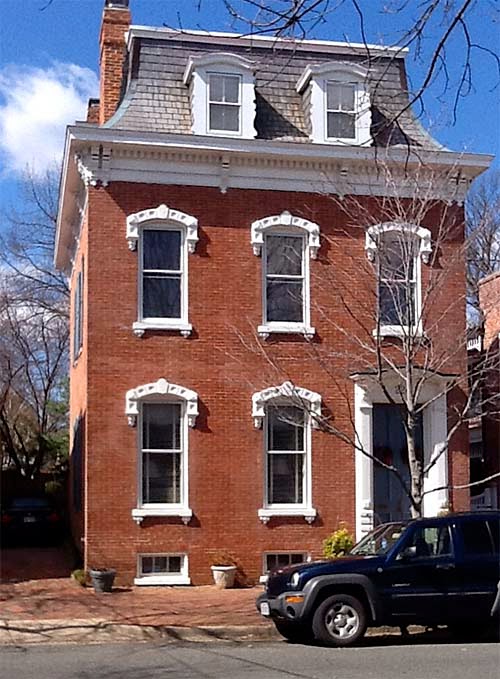
Turning back to the residential streets, I always admired this house. It is simple, understated, yet highly elegant probably for its restraint and proportions. Although Alexandria was wealthy and boomed during the 1800s, the extravagance of the Victorian era never caught on. Italianate style (in a row house urban environment) dominates. It is characterized in this house with tall narrow windows, muscular ornamentation used sparingly, simple segmented arch (metal) hood moulds over the windows, and a mansard roof. What's missing is the cresting (metal decorative railing) along the top of the roof.

With row houses along the sidewalk and few if any front yards, a pedestrian scale allows appreciation of details. Door knockers easily seen from sidewalks are one of the ways homeowners distinguish their homes. This one is found on a gate leading to a garden.

This door knocker proudly displays the symbol of the new country immediately after the revolution. Although the knocker is not old, the door itself is. Its panel construction is similar to that used today, but the panels are flush with the rails (horizontal and vertical frames.) Today's doors would have the panels recessed, as in the following photos.

And this newer home decided to go with the edible route. Pineapples would never do.

Another way of personalizing your abode is with a unique wreath. Staying with the fruit theme, if life serves you lemons, make a door wreath.

Nothing says spring like a wreath of bird nests full of eggs on a pink door.

If you can't have a watchdog guarding your house, how about a watchgargoyle at the front door to scare off intruders?

Take a good look at the brick on this house. To think all this decoration, from projections, patterns, and double negative corners, is from the same size 4" by 8" (10cm by 20cm) brick.


Old Town is not all stuffy and staid. Teddy, Ben, Abe, Ronnie, and a redhead I don't recognize beckon for some southern barbecue.

This is known as a spite house. There are a handful in Alexandria, but this is the smallest. They were originally built by the owners of alleys (back in the day I guess alleys were privately owned.) This owner got fed up with people using his alley for shortcuts to their backyards (where horses, wagons, etc. were stored) so, he built a 7-foot wide (2m) house on it for spite.

Hope you enjoyed your walk around. Visit other walk-offs at A Tidewater Gardener.

09 March 2014

Time To Wake Up

For the past three years or so, I have saved a few plants from the annual winter kill in order to replant in the spring. This is done either by keeping the plants going, or putting them into hibernation. I try out a new technique or two each year in the hope of having a better preservation success rate. The new tricks I am testing this year follow.

Canna
Here's how they roll. About three Pretoria canna tubers are planted in the garden in the spring. They easily grow and multiply during the summer, (not large enough to bloom until July) loving the hot humid weather we are noted for. The three turn into about a dozen. They are lifted after the first frost and those tubers large enough to save are stored until the spring. I end up losing all but two or three over the winter to rot or desiccation. The remaining are planted in the ground again after the soil warms, about two weeks after the last front date.

I began dusting the tubers with copper dust before storing them, maybe preventing the rot. This past fall, I bagged them in peat moss, hoping for a better save success rate. They all dried out except for about five. I'll take that as an improvement.

Canna Experiment #2 - try to get them growing before putting them in the ground. They are now in moist peat/soil, barely below the surface. And, they have begun to swell with some pink coloration on the tubers, a clear sign that they are beginning to wake up and maybe have a head start this year (although there are no roots.)

Strobilanthes
I read about doing this to the Persian Shield. In the fall, I take cuttings of the freshest stem tips. After about a month in water, they root. These are planted in yogurt cups and placed on an eastern facing window sill in a cool unused bedroom for the winter. They are watered, and (at this time) start to produce flowers.

This has worked well for the past four years, and all plants make it through to be planted in the spring. Although not growing much in the winter, they stay green (they are purple in the hot summer) until ready to resume their lives out in the wild. This year, as with the cannas, I am giving some a head start by transplanting to larger pots before going outdoors, in hopes they will be large.

I first saw these plants at the Atlanta Botanical Garden at a whopping 5-6 feet (1.5 m) tall. There was probably a greenhouse involved in this somewhere.

Colocasia
This is my first experience with these beauties. A friend asked me how to overwinter them, because after digging them up, his all rot in winter. I explained my procedure with the cannas and suggested peat moss storage. He was overjoyed that about all of his Colocasia came through the winter, and thanked me with five plants, and some bulbs I will write about in the coming months.

I dug them up, dusted them, and placed them in peat. But they did not fare well, and most shriveled up. I will attribute this to their small underdeveloped size in the fall. Three were solid, so they were cleaned and wet. In a few days, all grew one or two clear, protruding gelatinous wormy things about 1/8-inch long (3 mm). I am hoping these are the beginning roots and not a fungus. I placed them in a damp peat medium, so stay tuned.

Cordyline
The Red Cordyline is the center of a pot on the deck, and has been brought indoors, pot and all, for three winters. It is placed at an east-facing french door, and watered less frequently through winter. It looks great now, and is beginning to develop a stem/trunk as the lower leaves are shed through the years.

Let's hear what you keep over the winter, and the methods you use.