Showing posts with label poppy. Show all posts

18 June 2023

Poppies

The Lauren's Grape poppies always get a head start in the season. Most were spectacular this year, although the later plants were stunted a bit.

The pink peony poppies were runts. They began germinating in spring as the temperatures were setting records in the high 80s (high 20s C). For the past weeks, however, the weather has been a bit cooler that normal, but they still did not liek the hot April. There are blooms and I will save the seeds for next eseason and hope for mor appropriate spring weather.

09 July 2016

A Tale of Two Poppies

Pink Bombast Rose double-flowered peony poppies are very prolific. Every year these annual opium poppies come back, with some seeds sprouting in new locations: across the garden, across the sidewalk (across the universe?) This is important later in the story.

They do not like the 'instant hot' of our Virginia spring weather. Saving these seeds is a must for all the gardening friends that crave something different, beautiful, and easy. Seeds originally came from Johnson City, NY, growing in our back yard when our family moved while I was in the second grade. They survive zone 5 winters there and heartily return each year.

Lavender Lauren's Grape poppy seeds were picked up about four years ago at the annual local seed exchange i attend. I had seen them growing here and there, and thought they would be a great companion to the Bombast Rose. Lauren's Grape looks like a normal poppy with its single flower, central seed pod ringed by stamens, and dark band. They look like the perennial red poppies that I easily kill.

I noticed that both poppies are named papaver somniferum. The somniferum part is Latin for "sleep-inducing," named no doubt due to the opium. The pinks are kept in the front garden north, and the grapes were first sown in the side yard. The grapes did not do well on the north side of a fence and in soil that was (is) still-improving. Saved seeds were sown in the front garden south the following year.

The grapes bloom before the pinks, but there is a some overlap in bloom time. So, then along came this tiny little bee -- I had never seen bees on the poppies until then. Across the sidewalk from the pink bed, a magenta poppy appeared last spring; neither lavender nor pink, neither double-flowered nor single. Could this be the result of the matchmaker cupid bee? For 25 years here, the pink poppies have remained faithful, but now?

This year, a magenta, half-double-flowered poppy reappeared in the same place -- where I do not plant poppies. I saved the star-crossed, illegitimate seeds for next year.

For The Record:
  • Rich soil with good drainage
  • Full sun
  • Little or no fertilizer
  • No serious pests/disease
  • Poor showing in hot weather


Garden Calendar:
  • Blooming: cosmos, rudbeckia, echinacea, datura, marigold, zinnia, late daylily, daisy, cleome
  • Harvested: several onions, green beans

07 June 2015

Skyscrapers of Poppies

The purple poppy towers are blooming. Papaver somniferum have transformed the front garden, with pop-up poppy skyscrapers sprouting randomly: tall, slender, and crowded together.

These are opium poppies, single flowering in a strong magenta. They are not really tall, but their habit of springing up all over and their slender appearance remind me of a skyscraper skyline. They are also not really good for making opium or heroin, since these do not produce the large seed pods that are needed. There are cultivars bred for that purpose.

Some internet sources identified something like these as "Hungarian Blue," but my skyscrapers are not as big, not as tall, and the poppy seeds are not blue (like the edible type found in the supermarket spice aisle.) I do not know their name, but they were yet another seed exchange acquisition three years ago. I am very happy with this pickup.


My skyscrapers were first planted in the 'mountainside' garden (the side yard slope) in autumn. They appeared in spring but were unimpressive, probably because the mountainside was still undergoing "soil improvement." Saving the seeds, they were sown in the front garden with more sun, great soil, and where other somniferum, pink bombast poppies [posted 2013.06.02] could chat with them.


poppies, dill, onions, beans all living together
As chaperone, I of course kept them separated out of caution to prevent any after-hours dalliance. I just did not know if double pink and single purple would produce some one-and-a-half breed. The purples bloomed better in the front yard, although were not as large as the bombasts. Seeds were again scattered last fall. As with all good gardeners, I forgot where things were planted, marker labels washed off, and frost/snow disrupted them.

The pink bombasts have managed to seed themselves into the sidewalk cracks, across the sidewalk, and over the asters and physostegia to the other side of the bed. They really got around (damn I thought I picked off all those seed pods last year.) After all this carousing by the pinks, the purples and pinks are blooming together nicely, and there has been no sign of illegitimates.

P.S.
Some pink bombast poppies have hybridized with the other purple ones. A few purplish-pink single flower poppies have bloomed in the batch of pink ones, planted from seed taken from the pink ones. This is leading me to believe that the single flower trait is dominant, and that some of the purple fertilized the pinks last year to produce this new color.


The purples on the other hand, got spread around after tulips and dill were planted in the same spot - along with spring onions. So instead of a simple cluster, they have this haphazard appearance, like individual narrow skyscrapers, which is alright by me.

For The Record:
  • Good soil with organic amendments
  • Full sun
  • Small amount of fertilizer
  • No disease or pests

Garden Calendar:
  • Blooming: rudbeckia, phlox, poppy, geranium, datura,
    tradescantia, echinacea, eschscholzia
  • Harvested: lettuce, snow peas, green beans

31 March 2014

The Undead Zombie Plants

A quick walk through the gardens last week showed the extent of winter's damage. Zombie plants are everywhere. They appear dead, but may be undead -- ready to spring up from the earth to grow among the living again.

At a gardening lecture attended Saturday, everyone was wailing in anguish at the slow arrival of spring and the exceptionally harsh winter. One gardener complained that the temperatures dropped below the minimum temperatures of the USDA Hardiness Zone Map, not realizing its numbers are average low temperatures, not lowest. And then it snowed yesterday.

Zombies inhabit the side garden, located on the south side of my brick house and protected from northwest winds.

Rosemary
Come back to life?
The rosemary (Rosmarinus officinalis) provides fresh herbs for our grilled potatoes in the summer. It survived previous winters nestled in the side garden and was mulched in autumn.

The plant looks dead dead dead. Two semi-green leaves were noticed down inside the base after I took the shears to the plant last week. They did not appear as new sprouts, but as almost dead. The sprigs were plucked off and brought indoors for rooting. Hope is that the roots will rebound with a new plant later.

Lychnis
Rose Campion
It's alive.
This (Lychnis coronaria) was a donation to the dry garden last spring. Winter left it looking deflated. Like a good little zombie, it kept rising out of the ground during the winter, and I kept pushing it back down. Prognosis is good for survival after its first year, and after the frost heave.

Cardoon
Dead or undead?
(Cynara cardunculus) survived for the past three winters. Right now, there is nothing to photograph after the second cold wave turned what was left to mush, blackened and disfigured. Like the rosemary, hope is that a new plant will develop from surviving roots, but I don't know. That looked mighty black with rot down to the core.

Cutting Celery
Will it rise again?
Sprigs of this lived through two winters and came back healthy and spreading each spring, with some plants coming from reseeding. Today I can photograph only dirt, but hope new celery will again grow from last year's seeds.

California Poppy
Come back to life?
Expectations are high for the Schscholzia californica. Those not surviving past winters have prolifically reseeded across the platform steps to the other side of the garden. Today everything looks wiped out.
Belacamda Lily poking up

Belacamda Lily
Among the living.
Two years ago, (Belacamda chinensis) were planted from seed, and one bloomed. And then it died. Last year, more were planted from seed, two survived, and were well-mulched last fall. Expecting the worse after this winter, I was rejoicing at the pair that are among the living. The leaves are rising up, resembling bearded iris.

So today, it's Zombies 4, Living 2.

02 June 2013

Bombastic Poppies

My poppies are usually not big and loud, except for this year. These particular pink poppies are very unique to almost everyone who sees them, believing they are peonies. They grow and reseed each year at the back of my parent's garage in Johnson City NY (zone 5b). They came with the house, so no one knows anything about them.

Years ago, they were planted in my yard (zone 7a). The seeds are saved annually (although I don't know why since the poppies easily reseed themselves), planted in the fall, and in the spring pop up like poppies do. They have smooth solid leaves of a blue-green color like cabbage, and pink multi-petal blooms resembling shredded coleslaw. They are definitely poppies given the appearance of the seed pods, and given the manner in which they hang their heads until ready to bloom. After the internet came along, voila! - we now know they are: Bombast Rose Poppies (Papaver somniferum var. paeoniflorum).

They are essentially one of the opium poppies. (Fits well into my poison garden theme.) My advice for growing them: don't believe what you read on the internet about their cultivation. First, they should be planted in the fall and seem to prefer cool temperatures in spring - not very promising around here. Most all seeds planted in the spring turn into minuscule plants that get fried in the heat of late spring and summer.

Second, they hate to be transplanted, and never seem to recover from that shock. Third, they are anti-social plants - not liking crowded conditions. I find they seem to compete with each if close together. Fourth, they do not like heat. This last piece of advice relates to this year's crop.

In the past, a handful would grow to 3-feet tall (1 m) while others would remain midgets with almost no blooms. This year, there is the usual crop of midgets, but a few shot up to 4-feet (1.2 m) in height with gigantic blooms. The over-scaled plants began sprouting earlier than the others when weather was cooler. This may have given them a head start. When the weather changes a bit, the heat seems to toast their lower leaves, reducing the amount of food for the plant, my guess. We had a somewhat cool spring this year, so the plants with the head start really took off early while the others were affected by the heat as they began to grow.

For The Record:
  • Rich well-drained amended soil
  • Full sun
  • Small amount of fertilizer
  • No serious pests/disease
  • No fragrance


Garden Calendar:
  • Blooming: pink poppies, nicotiana, coreopsis, salvia, california poppies, tradescantia, rose, cactus

06 May 2012

California In Virginia

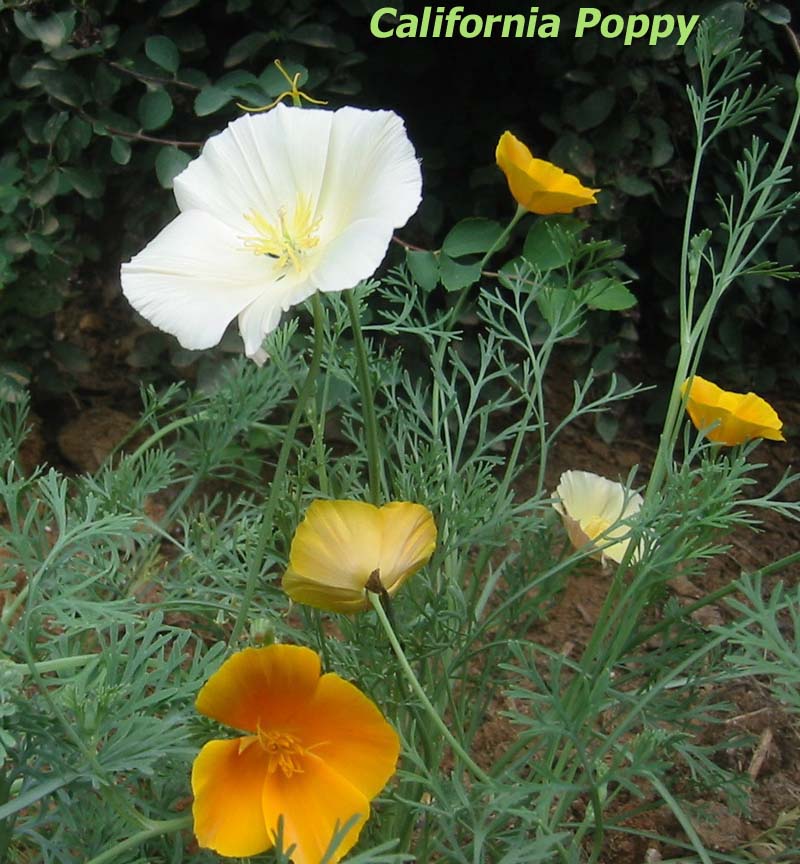
A month earlier than last year, the California Poppies (Eschscholzia californica) are blooming their pretty little butts off. These are the same that were planted from a free seed mixture last year and overwintered on the south side of the house in my protected micro climate. As reported earlier, these annuals can survive a winter if there is no severe ground freeze (as in last year's mild winter.)

There were yellow, orange, and creamy white last spring and grew about 6-inches tall (15 cm). The white ones disappeared this year, and the plants that overwintered are a bit taller at a foot (30 cm). There are also some interesting variations in the remaining oranges and yellows. Some yellows have an orange halo on the interiors. Some of the oranges have a deeper orange blush within the petals.

I like a plant that requires a second look. From a distance, my California Poppies are solid yellow and orange. Closer, the details in the color variations of petals are evident. Foliage is feathery blue-green. The seed pods are long tubular spikes, some evident in the photo.

They make a poor cut flower since they open in the sun, and close at night and on cloudy days. That's a bummer when trying to photograph them. Bright direct sunlight is too harsh and contrasty for plant photography.

I learned that these are native wildflowera to the Unites States, and have been introduced in Austrailia, Chilie, and Europe. In Chilie and the US, they can be behave like an invasive species.

They are drought-tolerant and do best in poor soil. That explains why they love my garden - in my clay without a lot of organic material. They like cool weather and disappeared during last year's summer.

For The Record:
  • Clay soil with good drainage on a slope
  • Full sun, south side of a brick house
  • No serious pests or disease


Garden Calendar:
  • Blooming: nicotiana, salvia, allium, calendula, bearded iris

08 July 2011

Ankle Deep In Poppies

My seed order came in spring with yet another free seed packet of something I didn't order and didn't know where to plant. Upon closer examination, this free seed packet was filled with poppies - how could anyone refuse free poppies? And these were California Poppies (Eschscholzia) to boot. I am not sure which exact species these ankle-high babies belonged to.

I read the seed packet to learn more about the booty of treasure I had been blessed with. OK, now I get it:
Packed for 2010. Sell by 10/31/10.

I threw them outside in full sun, in clay soil, along the platform running down the side garden. They took their sweet time in germinating, and then began filling in the small space with blue-green lacy foliage as I had imagined. They were off to a good start.

After our hot weather hit, they started blooming. Only 9 inches tall at most (20 cm), the plants barely made it up to the raised platform surface. The first blossoms were biggest, then as the weather got hotter, they decreased in size. The mixed colors of red, orange, yellow, and cream on the seed packet turned out to be mostly yellow, with a few cream.

I was a bit disappointed in the limited number of blooms. In fact, the number opened at one time never amounted to more than 20% of the plants. I was hoping for the showy displays in the Dave's Garden photos and on the seed packet. They were, however, planted in Virginia clay, and never thinned out as the seed packet recommended. Who thins out outdoor seedlings?

In researching some facts about my tiny beauties, I found that they are native to North America, but named after Johann Friedrich von Eschscholtz, a German botanist. They are toxic (so they are at home in my 'poison' garden.) Native Americans used Eschscholzia californica to treat lice, and to induce sleep in children. (I hear toxic plants usually do that to children.)

"This species is highly variable (more than 90 infraspecific taxa have been described), not only among different plants and locations but also within individual plants over the course of the growing season, especially in petal size and color."
An interesting feature on the plant is the seed pod. It starts out small inside the flower, then grows into a 3-inch long (7 cm) string bean after the blossom dies. I will try collecting seeds for next year to cultivate more blooms if they are not self-reseeders.

For The Record:
  • Heavy clay soil with some peat amendments
  • Full sun
  • No serious pests or disease


Garden Calendar:
  • Blooming: pink & orange cosmos, rudbeckia, nicotiana, liatris, cleome, coneflowers, marigold, echinops,
    coreopsis, calendula, loosestrife, rose, physostegia, eschscholtzia, daisy
  • Harvested: 3 grape tomatoes

06 June 2008

Poppies Pooped Out

Two years ago I joined the National Home Gardening Club and received a packet of poppy seeds. (The packet showed a bunch of red flowers.) They were planted in the fall, and springtime brought only two plants - one with pink flowers and one with red. Seeds were saved from both and planted in fall again, and this year produced - voila - only one plant with red blossoms. Did these seeds ever hear the phrase 'field of poppies?' Maybe they do better if planted in the spring.

This one is a Shirley Poppy, (papever rhoaes). From one base stem, the plant produces dozens of branching stems each with a hairy flower bud. Flowers are carmine red with four petals, two tend to turn up and two turn down after hot sun hits them. As with the peony poppies, the blossoms do not last long. The branching stems are falling all over like a giant spider, selfishly hogging too much space in the bed for one plant. This poppy would probably look better if it had several of its friends together in one group.

For The Record:
  • Growing in somewhat heavy soil, full sun
  • Light liquid fertilizer
  • Very low germination rate with fall planting
  • Non-compact, branching habit

25 May 2008

In Praise of Fertilizer

These poppies are very unusual and are easily grown from seed each year. The multiple ruffled petals give the appearance of peonies, and the blue-green foliage has the appearance of a cole vegetable plant. The seeds are sown directly in the ground in fall.

These were obtained from a yard outside Binghamton, New York, where they have prospered for decades in an upstate New York climate. They have not been specificallly identified from any garden catalog, although peony poppies are found in various nooks and crannies on the internet, and seem to come in purple and dark red in addition to this pink.

This year, a few of the plants really took off in height and size, while the remaining plants are average. All were planted in the same plot and fertilized with slow release organic fertilizer in the spring. The larger ones, however, were planted very close to alliums, which had the benefit of bone meal fertilizer applied in the ground in the fall. Lessons learned.

For The Record:
  • Growing in medium soil, full sun
  • Slow release organic granular fertilizer, some bone meal in the fall
  • Does not transplant
  • Blooms do not last long
  • Unusual color & flower gets ooo's & aah's


Garden Calendar:
  • Blooming: poppies, calendula, purple salvia, geranium, nicotiana, foxglove