Showing posts with label winter. Show all posts

19 March 2016

Winter Walk-Off

This year, I stayed in Old Town Alexandria again where my office is located. There are more interesting things to photo. I took most of my walk on the south side of our main street -- King Street. The streets through the town center are named after royalty: King, Queen, Princess, Duke, and Prince Streets. Oddly, there is no Duchess Street.

Mostly historic architecture is included this year (taking a cue from our walk-off host), on what was the more affluent side of town, where homes are brick (instead of wood), and are three stories (instead of two). All photos were taken with my cellphone -- a first (and a test) for this blog.

To be well read, visit this local dress shop before your next dinner party.

Stabler Leadbeater Apothecary Shop is now a museum, but provided compounds and cures for years -- like to George Washington. Love the unique curved glass in the windows. On a tour, I remember seeing containers labeled "Dragon's Blood" and "Hound's Tooth." (I could not find eye of newt or wing of bat.) A curator mentioned that some compounds were unknown or labeled with strange names, and that no one today knows what they are, where they came from, or what they were used for. This 'drug' company operated until the 1900s when the newly formed FDA began requiring disclosure and regulation of ingredients in pharmaceuticals (and proof that they were effective.)

Someone lost his head outside an antique store (in the hell strip).

Fire fighting was very important in an urban early America. Fire fighting companies were private and in competition. The one-bay station house to the left of the main fire station was home to the "Relief Fire Company." This was one of several fire companies in town.

This plaque tells the story ... of a building across from the firehouse. The building is in the left-center of the photo below.


Two blocks away, another firehouse, the Friendship Firehouse is now a museum.

This was building was entrance to (what else) the Elks Club, and is now full of condos.

Fawcett-Reeder House, privately owned, with the rural-like setting, might have been built before the more urban townhomes in town. (Can't get the blasted street signs or cars out of the photos.)

And here is another spite house. The most famous one in town was profiled in a previous year's walk-off. Look for the door to the basement ice chamber.

Examples of the wealthy homes built in the 1800s. Most are in an Italianate style -- fitting the more conservative residents.

This is one of my favorites -- but the owners were probably outcasts and snubbed for building such a highly decorative, flamboyant house - a MacMansion of the time.


Gentry Row is a block of townhomes built by wealthy merchants. Brick paving in the street is cool.

Captain's Row is a block with many homes built by wealthy sea captains. This street, a bit older, is paved with cobblestones.

This museum is a stunner. It was originally a bank, right in the middle of a residential neighborhood at the end of Gentry Row -- before zoning regulations.

Stinky, dirty, smelly warehouses were found down near the river near the docks and wharfs.

They are now full of restaurants and shops.


A newer building near the river marks the water elevation. The river is at sea level, and does flood. When severe, water comes up into the lower streets and buildings. In recent years, this happens more frequently.
2015 Walk-Off
2014 Walk-Off
2013 Walk-Off

Hope you enjoyed your history lesson and tourist promo. Visit other winter walk-offs with Les at A Tidewater Gardener.

18 December 2015

Christmas Wreaths of Old Town

The row houses in Old Town Alexandria do not have much front area to decorate. As a result, attention is paid to what decorations there are. They can be quite unique with beautiful details, since they are viewed by pedestrians up close from the brick sidewalks. These are some of my favorite creative door wreaths found this year. Four of them, I have heard, are from a former White House floral decorator. Leave a comment at the end and guess which ones.

Mmmm. Delicious. Red delicious. Fruit are a popular material.

Red, green, gold and white make a nice contrast on a dark colored door.

New meaning to the term "box"wood. Square wreaths are more and more popular each year.

And even fruit is boxed. Love the red against the navy blue. What are those leaves?

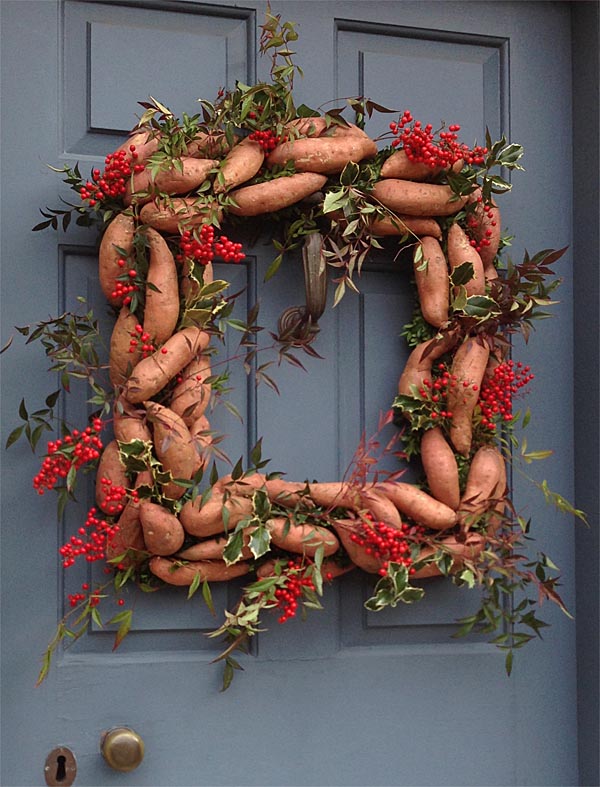
Who thought sweet potatoes and nandina were companions.

Staying with the root crops theme, red potatoes, nandina, pachysandra, and who knows what else all tied together with purple ribbon.

Berry Christmas. Using nothing but all kinds of berries for the wreath instead of just for accents.

Not enough holly forces some into using brussels sprouts.

Magnolia leaves with the brown undersides combined alongside the more popular green top sides.

How does the song go ... "Marshmallows roasting on an open fire..." A very sweet design for a black door. I did a triple take when I saw this one, needing to verify that these were real marshmallows.

Show us your favorite wreath creativity.

24 January 2015

In Between

Here am I between two storms. A rain-sleet-snow-freezing rain "event" happened overnight and snow is predicted for tomorrow night. We are also between the seasons; at a midpoint with the light at the end of the winter tunnel. Next stop on the bus: spring.

The signs are there. Some things in the garden are beginning to stir. And next Saturday is the annual Washington Gardener Magazine Seed Exchange in Virginia. Coming home afterwards with a bucket full of new seeds to try out gets the gardening juices going again.

A trip around the yard found some heads poking out. No sign of the crocus though.

Daffodils need not be afraid.

This tangled muscari mess actually started coming up in November. Does muscari need dividing? The hairy bittercress beyond is doing nicely.

Dutch iris always starts in the fall, unless you plant the bulbs in the fall - then they start late. I see the spiny sowthistle is also getting a jump on the season.

The incredible spreadable rose campion. Started with two plants, but now it is traveling down the hillside. Invasive is my middle name. The blue fescue is enjoying the weather.

Miniature iris planted first time this fall. I can't remember what they are, but think they were dual color. There is a story about that white marker:

I hosted our neighborhood plant swap last May, and one of the neighbors brought some cut up vinyl blind slats to use as plant labels. They work well. Until then, I used popsicle sticks that would compost into the soil. But the titles washed off these over winter, and they degrade before they are supposed to. This one is holding up.

31 March 2014

The Undead Zombie Plants

A quick walk through the gardens last week showed the extent of winter's damage. Zombie plants are everywhere. They appear dead, but may be undead -- ready to spring up from the earth to grow among the living again.

At a gardening lecture attended Saturday, everyone was wailing in anguish at the slow arrival of spring and the exceptionally harsh winter. One gardener complained that the temperatures dropped below the minimum temperatures of the USDA Hardiness Zone Map, not realizing its numbers are average low temperatures, not lowest. And then it snowed yesterday.

Zombies inhabit the side garden, located on the south side of my brick house and protected from northwest winds.

Rosemary
Come back to life?
The rosemary (Rosmarinus officinalis) provides fresh herbs for our grilled potatoes in the summer. It survived previous winters nestled in the side garden and was mulched in autumn.

The plant looks dead dead dead. Two semi-green leaves were noticed down inside the base after I took the shears to the plant last week. They did not appear as new sprouts, but as almost dead. The sprigs were plucked off and brought indoors for rooting. Hope is that the roots will rebound with a new plant later.

Lychnis
Rose Campion
It's alive.
This (Lychnis coronaria) was a donation to the dry garden last spring. Winter left it looking deflated. Like a good little zombie, it kept rising out of the ground during the winter, and I kept pushing it back down. Prognosis is good for survival after its first year, and after the frost heave.

Cardoon
Dead or undead?
(Cynara cardunculus) survived for the past three winters. Right now, there is nothing to photograph after the second cold wave turned what was left to mush, blackened and disfigured. Like the rosemary, hope is that a new plant will develop from surviving roots, but I don't know. That looked mighty black with rot down to the core.

Cutting Celery
Will it rise again?
Sprigs of this lived through two winters and came back healthy and spreading each spring, with some plants coming from reseeding. Today I can photograph only dirt, but hope new celery will again grow from last year's seeds.

California Poppy
Come back to life?
Expectations are high for the Schscholzia californica. Those not surviving past winters have prolifically reseeded across the platform steps to the other side of the garden. Today everything looks wiped out.
Belacamda Lily poking up

Belacamda Lily
Among the living.
Two years ago, (Belacamda chinensis) were planted from seed, and one bloomed. And then it died. Last year, more were planted from seed, two survived, and were well-mulched last fall. Expecting the worse after this winter, I was rejoicing at the pair that are among the living. The leaves are rising up, resembling bearded iris.

So today, it's Zombies 4, Living 2.

08 February 2014

Paper-Yellows

Surprise the customers. I bought paperwhite narcissus at a local nursery last year after searching throughout town for the least expensive. I was buying for the master gardeners. I am VP of Training, and it was graduation time, when the rookie newbies were graduating from the training program to CERTIFIED master gardener status.

It was a custom to hand out a small goodie bag to the graduates as they walked across the stage (front of the room) to receive their diplomas (certificates) and shake hands. I put together the best goodie bag ever with the extremely limited funds available. Included among some symbolic and useless items was one paperwhite bulb. My best price was $0.99 each.

After class, I went back and bought six more bulbs for myself and planted them in time for a Christmas bloom. Four responded on schedule. A few more lallygagged well into January.

And, then yellow. The late bloomers were yellow (obviously a different variety with different bloom characteristics). I wonder if any master gardeners got yellow, after their training coordinator labeled them as paperWHITES.

Speaking of color, one sunrise greeted me with some after a January snowfall.

Red sky at morning,
sailors take warning.
Red sky at night,
sailor's delight.


We got another snowfall after this morning sky.

14 January 2012

Free Range Poinsettias

Do I have a green thumb or what?
How many people keep poinsettias after Christmas and try to get them to rebloom the next year? And how many people, with fungus gnats, white flies, and yellow leaf drop throw in the towel and throw the darn thing away? They may be cheap but they're not easy.

Two years ago, I planted a cheap holiday poinsettia (Euphorbia pulcherrima) outdoors in the spring. I wanted to give it a chance to live on past its normal life expectancy so retired and moved it to a warm sunny southern climate.

The southern side yard was a perfect place, and it grew quite well. In the fall, the new leaves became smaller, grew more slowly, and had a red tinge to them and their veins, like we all do after too many merlots. The experience was encouraging and rewarding, as reported that year. [21.10.2010]

This spring, I placed two potted poinsettias from last Christmas in the side yard, hoping to decide on a placement later. Laziness set in and 'later' turned into 'never.' They stayed in their pots with their original soil. In the fall, due to cold and longer nights, they began their change again. Our frost came very late this year; so as long as they were not yet compost fodder and not in the way of the fall garden chores, they stayed.

They were moved to the deck, close to the warmer house after the first light frost, and eventually made their way indoors. I decided to keep them going to see what would happen to those reddish leaves. Every evening upon retuning home from work, I stumbled around a dark house to find my poinsettias and move them from their sunny daytime french doors and place them in the dark cellar near the outside door. Every morning, I reversed the routine (but needed not stumble) or placed them outdoors on those occasional warm days. Poinsettias need long nights to bloom and bloom they did in time for Christmas.

One plant was purchased at an inexpensive supermarket, and the other at Home Depot. (No need to spend oodles of bucks on throw away plants during the holiday shopping season.) The National Poinsettia Cultivar Trials indicates there are hundreds of varieties. My two show notable differences.

One has dark green leaves, and much larger blooms than the other lighter green leaf. But, this one with the naked legs lost more of its lower leaves. Both plants have smaller blooms than when purchased, and much stronger stems. I will attribute this to not being fed a constant junk food diet of fertilizer. I remember that whole stems on both plants easily broke off after purchased, maybe due to the soft fast growth promoted by production nursery greenhouses.

The red flowers are actually bracts (like dogwood tree 'petals') and have so far lasted a month. The yellow flowers in the centers are just now beginning to bloom. Next year I promise to take better care (larger pots, pruning, and some love) during the summer and hope to write about the larger blooms in 2013.

07 January 2012

Alexandria Holiday Decoration

It was a busy time during the holidays, and without many plants growing, there was not much material for the blog. I thought another yearly door decoration post might be in order.

Over the past few years, a securities company across the street from my office in Old Town Alexandria decorates its front door in true colonial style. Natural fruit and greens adorn the door and transom window during the holiday season.

A few years back, I took a candlelight tour of nearby Mount Vernon. George Washington and his friends celebrated Christmas, but it was not the holiday it is today. Decorations, understated by today's standards, were usually natural greenery. Plants that magically remained green through this bleak time of year held a special significance and were thought to bring life and good luck to the household.

December 25 was the beginning of the Christmas season, culminating with the more important feast in January, twelve days (of Christmas) later. Gatherings of friends for dinner, games, and music were the important items for the holiday here in Virginia - not the trimmings and trappings. Any fruit used as interior decoration was eventually eaten.

These Old Town door decorations consist of boxwood wreaths on the door, and actual oranges, pineapple, grapefruit, and apples above. I do not know what the sprig is at the pineapple - it looks like amaranth.

26 March 2011

Overwintered and Underwhelmed

As stated previously, a few annual plants are overwintered on a window sill and given a new life in spring. This is the second winter I tried this, and hoped to improve on last year by using larger pots and taking more cuttings. So far, the results are mixed. I am not convinced the additional effort was worth the results.

Coleus Dark Chocolate (Solenostemon scutellarioides)
In winter 2009, one cutting was made. It rooted in water and was planted in a small cup. In spring, after almost no growth over winter, it was planted outdoors. It grew last summer, but never reached the original size it was when purchased. Last fall a few more cuttings were taken. All but one died off. The survivor was potted and a second cutting was taken from it last month. The plants are no different than last year's at this stage, although there are two.

Coleus Kong Red (Solenostemon scutellarioides)
My other coleus had similar results during its first winter. Although both cuttings survived, they stayed small during winter and did not grow much during the summer. This winter, three cuttings were taken and potted. A fourth was started from one of these midway through winter. All are doing well. Plants in the larger pots are larger than last year's overwinters, so the pots made a difference here.

Pesian Sheld (Strobilanthes dyerianus)
Two years ago, two cuttings rooted and survived the winter in their small pots. When planted outdoors, they grew well into respectable plants. This year, five cuttings were taken. Two were placed in larger pots than the others, but all appear to be the same size at the moment. Apparently, size (of the pot) doesn't matter.

Patchouli (Pogostemon cablin)
This plant was picked up at the end of summer sale at a local nursery, and has stayed in its pot during winter. It has prospered indoors, doubling its size and looking forward to a season of outdoor growing.

15 February 2011

February 2011 Bloom Day

Garden Bloggers' Bloom Day
What's blooming in the garden on the 15th of the month.

A second Strobilanthes on the window sill just flowered, but I caught the photo a day too late. The Christmas poinsettia is still impressive, and waiting patiently to be planted outdoors and to continue as a summer annual foliage plant. The hyacinths started indoors in early November are now blooming, about a month later than expected. This light blue one is 'Sky Jacket.' I can't believe the amount of roots they put out!

Find other garden bloggers' February bloom days at the blog May Dreams Gardens.

Strobilanthes dyerianus

Poinsettia (Euphorbia pulcherrima)

Hyacinth 'Sky Jacket'