21 July 2015

High Line Impressions

While on a trip to New York City, a visit to the High Line was high on my list. This is the old elevated railroad that was preserved and turned into a park. Overgrown with weeds and plants, it was 'rehabilitated' into a walking landscape; transformed from a rusting eyesore to an urban park and walkway with views. Watering systems, soil, stairs, elevators, and of course vegetation were installed on the old structure. I imagine the steel structure had to be beefed up in some spots, too.

It is a phenomenal success story. I have a link to the High Line blog (on the right sidebar.) I read that it is inspiring similar park projects in other cities, too, like Chicago, London, and here in Washington, DC.
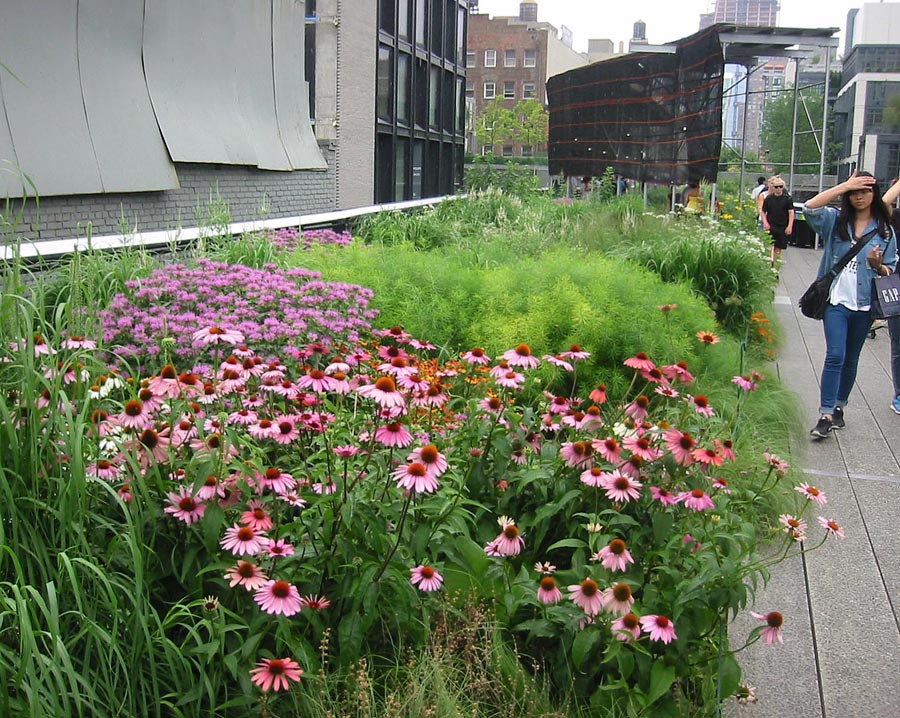
The plantings contain a lot of native species like echinacea, monarda, grasses and sedges.


Liatris near the edge. I believe there is a continuous light in the railing along each edge, but I was not there in the evening to verify.

There were areas where the old rails were preserved to remind us of its past purpose and use.

The paving blocks were notched at their ends to allow small slivers of planting bed to penetrate the paving edge -- blurring the edge between paving and plants. This created an appearance of the vegetation slowing creeping into the paved areas, like it does on an old paved road (or railroad.) The granite paving matches the color of the crushed stone of a railroad bed.

Benches were designed to appear as if they are a continuation of the paving -- almost like the paving was lifted up. Unfortunately, this also creates a tripping hazard.

There are movable lounge chairs. In keeping with the railroad theme, they are on wheels and roll on the rails.

This is not just a wet sidewalk. Delighting the senses, this water feature is a pool of water where one cannot drown. It is only about 1/8" deep (3 mm) and can be walked on in order to sit at the benches. (Sorry, the slight rain doesn't help the photo.) A perfect place to splash barefoot.

Artwork also delights the senses. A sculpture of graffiti is placed along the perimeter, spray-painting on the imaginary wall at the edge.

The walk also contained some shady areas where it proceeds under a grove of trees.

Success has allowed the High Line to be extended twice. This urban park is helping to spur redevelopment along the western side of Manhattan's old meat packing district. New residential condos, hotels, shops, offices, and new Whitney Museum are springing up and bringing more people (and tourists) and 'upscale' to one of the remaining industrial areas of Manhattan. I have mixed feelings about this change.

15 July 2015

July Bloom Day

It has been a month since the last post. No excuses are offered but another rush out the door after work today to snap a few photos hopefully makes up.

Echinacea is very thick and the goldfinches are probably drooling waiting for the seeds to be ready.

One flower finally opened on this particular zinnia, 'Oriole'. I was expecting more of an orange hue.

Pollinator-magnet liatris is nearing the end of its bloom. Funny, as it blooms from top down each stem.

Rudbeckia 'Irish Eyes' reseeded after blooming early this year. This result grew up and bloomed already - without green eyes.

This Rudbeckia hirti plant developed some brown markings.

It's not a ditch lily, but a double-ditch lily. And, it grows in semi-shade and is thriving.

My newest daylily 'Cherokee Star' seems to bloom one blossom at a time. Its location does not allow a good angle for photos.

Monarda 'Violet Queen' looks a little sparse. It probably needs more sun than it gets now.

Echinops is in varying stages of bloom. Bumblebees love it.

I love this marigold 'Tiger Eyes', and it reseeded itself true to form. Dark green, thick, lush foliage and no problems.

Cleome seeds found their way 60-feet (18 m) down the hill into a shady spot all by themselves, and grew. I let them. Anything that makes that journey deserves to live.

For the first time, a few little sky blue Platycodons germinated from last year's seeds. I guess some like the extra shot of winter.

Only five cosmos plants came up this year after the severe winter - the least number ever - but they still look full. Zucchini makes a nearby foliage plant in my front yard.

For other garden bloggers' bloom day photos, check out our host at blog May Dreams Gardens.

15 June 2015

June 2015 Bloom Day

Lots of things are popping out of the gardens - 'Never Looked So Good' should be the theme applied to many garden inhabitants this month. Onion and green beans comprise the bounty to date, and go well together in a three bean salad. Fresh basil and oregano work wonders on a grilled pizza. More hot weather is on the way, though.

The datura is off to a great start and has never looked so large this early. This is the second time I have grown this moonflower, and hope it does better than the first which was in a more shady spot.

'Night of Passion' is what I think this daylily is called, after viewing 100,000 photos online.

The hydrangea has never looked so good. Although I wrote about my Annabelle hydreangea, a fellow master gardener believes this one is not Annabelle because the blooms are too enormous and perfect. 'Incrediball' is probably the correct name. Ignore my sorry attempt at staking.

Even the hostas are getting in on the bloom fun.

Another bloomer that has never looked so good this year. After years of care, 'Miss Lingard' phlox is now an established perennial that needs no attention. How did I end up with so many whites? They do look cool in this hot summer weather.

Lychnis coronaria has so many names I am reluctant to call it anything but its formal name. When they are planted together, they look like a fun bunch. But pulling out their thousands of seedlings (as bad as cleome) is not fun.

Tradescantia was moved last fall to a shadier location, and it loves its new digs. Never blooming into the hot weather except for this year, it is yet another one that has never looked so good.

Finally, the first photo of phase 1 of my hell strip beautification attempt. It is surprising how many neighbors see this, but don't notice the larger cottage garden in the front yard. Thanks to Scott at Rhone Street Gardens blog for the inspiration to do this.

For other garden bloggers' bloom day photos, spring over to the blog May Dreams Gardens.

Garden Calendar:
  • Blooming: rudbeckia, phlox, poppy, geranium, datura, tradescantia, echinacea, phlox, lychnis, hydrangea, hosta,
  • Harvested: green beans (bush) 1 onion

07 June 2015

Skyscrapers of Poppies

The purple poppy towers are blooming. Papaver somniferum have transformed the front garden, with pop-up poppy skyscrapers sprouting randomly: tall, slender, and crowded together.

These are opium poppies, single flowering in a strong magenta. They are not really tall, but their habit of springing up all over and their slender appearance remind me of a skyscraper skyline. They are also not really good for making opium or heroin, since these do not produce the large seed pods that are needed. There are cultivars bred for that purpose.

Some internet sources identified something like these as "Hungarian Blue," but my skyscrapers are not as big, not as tall, and the poppy seeds are not blue (like the edible type found in the supermarket spice aisle.) I do not know their name, but they were yet another seed exchange acquisition three years ago. I am very happy with this pickup.


My skyscrapers were first planted in the 'mountainside' garden (the side yard slope) in autumn. They appeared in spring but were unimpressive, probably because the mountainside was still undergoing "soil improvement." Saving the seeds, they were sown in the front garden with more sun, great soil, and where other somniferum, pink bombast poppies [posted 2013.06.02] could chat with them.


poppies, dill, onions, beans all living together
As chaperone, I of course kept them separated out of caution to prevent any after-hours dalliance. I just did not know if double pink and single purple would produce some one-and-a-half breed. The purples bloomed better in the front yard, although were not as large as the bombasts. Seeds were again scattered last fall. As with all good gardeners, I forgot where things were planted, marker labels washed off, and frost/snow disrupted them.

The pink bombasts have managed to seed themselves into the sidewalk cracks, across the sidewalk, and over the asters and physostegia to the other side of the bed. They really got around (damn I thought I picked off all those seed pods last year.) After all this carousing by the pinks, the purples and pinks are blooming together nicely, and there has been no sign of illegitimates.

P.S.
Some pink bombast poppies have hybridized with the other purple ones. A few purplish-pink single flower poppies have bloomed in the batch of pink ones, planted from seed taken from the pink ones. This is leading me to believe that the single flower trait is dominant, and that some of the purple fertilized the pinks last year to produce this new color.


The purples on the other hand, got spread around after tulips and dill were planted in the same spot - along with spring onions. So instead of a simple cluster, they have this haphazard appearance, like individual narrow skyscrapers, which is alright by me.

For The Record:
  • Good soil with organic amendments
  • Full sun
  • Small amount of fertilizer
  • No disease or pests

Garden Calendar:
  • Blooming: rudbeckia, phlox, poppy, geranium, datura,
    tradescantia, echinacea, eschscholzia
  • Harvested: lettuce, snow peas, green beans

01 June 2015

Green-Eyed Monsters

Their eyes do not stay green. After a few weeks, they begin turning brown and go completely black - just like vampires in horror films. They do not, however, glow red, at least not yet.

Green-eyed susans are what I call them in the presence of my neighbors, allowing them to understand this plant as a form of black-eyes susans. Rudbeckia Hirti - Irish Eyes concluded my second attempt at growing from seed, and a successful lesson in persistence. In the first attempt, all seeds were sown directly in the ground, some germinated, and all passed on for no apparent reason. (Apparent to me.)

I thought to add them to my bucket list of plants (that kicked the bucket) and move on, but I spotted a pack of seeds at the annual seed exchange. I decided to take a chance on the expired seed pack. A few eyes were started indoors and three germinated. They were transplanted last spring, blooming a little last year -- their first year.

This year, the three returned from the hard winter, but one was hurting. Two were merrily growing tall, so I quickly quarantined (pulled out) the sick one, hoping that whatever winter flu it caught was not contagious.

Irish Eyes flowers display narrower petals than my other rudbeckia. Height is about the same at 3-feet (1 meter), which surprised me. I expected shorter. These are robust plants producing loads of flowers. Great posture too; every flower is horizontally flat. They grow fast, and are blooming already before the other rudbeckia.

Like the Rudbeckia hirti, they have come back strong in their second year. I will expect that they too will probably fizzle out next year while their seedlings taking over. My rudbeckia are known as half-hardy perennials. Eyes have last year's offspring growing around in the bed, so I will let them grow to learn if they come back as Irish, (or if their parents have been fooling around with the Mexican zinnias).

amplexicalis
fulgida
occidentalis
I looked for a story behind Irish Eyes and could only find that they are a cultivar (human bred) and not a variety (natural variation). I did find interesting tidbits about rudbeckia.

They are native to the United States east of the Rocky Mountains, and were found in the New World in the 1600s by John Tradescant through French settlers. The originals, like many North American natives, found their way into European gardens, and were rediscovered and planted in American gardens in the mid 1800s. Rudbeckia were named after a Swedish professor of botany, Olaf Rudbeck.

"Rudbeckia are pollinated by insects and, in at least three species, the ultraviolet (UV) reflection patterns are different enough to allow for pollinator discrimination." This is one way pollinators can distinguish between cultivars and species of natives, even though everything else looks the same to us.

There are two dozen species of rudbeckia in North America. Some of the more popular ones are Rudbeckia amplexicalis (aka clasping coneflower or Mexican hat), Rudbeckia occidentalis (aka green wizard), and Rudbeckia fulgida (aka Goldstrum).
(Cultivar photos are not from my garden.)

For The Record:
  • Rich soil with organic amendments
  • Full sun
  • Small amount of fertilizer
  • No disease although attracts black aphids

Garden Calendar:
  • Blooming: rudbeckia, phlox, poppy, geranium, tradescantia

19 May 2015

Three Year Wait Is Over

The 2012 plant swap peony has finally bloomed today. It was the only peony (Paeonia lactiflora), and I got it. Its owner did not remember its color or variety.

In its third year now, the thing sent out several stalks this spring, and there was hope in the air. One of the stalks had three buds, and the first opened to a deep magenta, double-ruffled flower. There is a nice fragrance. We had a violent rain downpour last night, and it survived without incident.

It was planted in the side garden bed, the newest and therefore the one with the poorest soil. I placed a wire support disc as it grew, just in case it needed one, and it grew through. Rather tall at about 40-inches high (1 meter), the bloom is normal sized. It might be tall or lanky because it gets morning and afternoon sun, but is in shade around midday. Full sun is what I believe they need.

I don't have the heart to cut and bring indoors to enjoy it.

15 May 2015

May 2015 Bloom Day

Garden Bloggers' Bloom Day
What's blooming in the garden on the 15th of the month

Projects (including working in the garden,) have been taking time away from blogging this spring.

Nothing much on this bloom day, my 16th since blogging. Bearded iris galore, but you've seen them last year. May is a dead time in my garden before most impressive perennials get going and after the spring bulbs. So I tried for some smaller closeups, but need to get a new camera - this pocket Cannon Elph I used for all my photos over the past 12 years is beginning to show age with less and less clarity.

Kalmia latifolia 'Sarah' is "one of the reddest mountain laurels" according to the catalog.
This is one of the first plants I bought years ago after moving into my house.


Iris hollandica 'Discovery'. I divided one clump last fall into three this spring.
They are not as impressive (spread apart), but maybe next year...


Add unknown geranium sanguineum. Spreads like crazy, blooming intermittently throughout summer.


Geranium macrorrhizum 'Bevan's variety'


Camassia leichtlinii never takes a bad picture


Couldn't resist adding an annual I really like this year - petunia 'Phantom'

For other garden bloggers' bloom day photos, spring over to the blog May Dreams Gardens
.

24 April 2015

My Tulips Smell

Being in an area that goes from winter to summer in a two weeks, growing tulips is a challenge. In about the span of one week, they open, bloom, and get fried to a crisp. In subsequent years, whether left in the ground or lifted in the spring and replanted in the fall, they are a big disappointment. So like an addict, I try to stay clean of spending money on tulips.

Every so often in the fall, photos on the tulip packages in the local nurseries (along with a discounted price) tempt me to a point of giving in. And after they bloom one year, my tulip has-beens proudly produce big leaves year after year, but no more blooms. Oh, every other year of so, one might pop out a bloom before going back to growing leaves.

In some years, I fertilize them up the wahzoo and water them frequently. But the weather sears them quickly before they have a chance to develop enough to bloom the following year. And this year we have Princess Irene tulips, the result of my latest willpower breakdown last autumn. They have bloomed now for over a week, probably because of our unusually cool spring.

This week, as I walked by, I noticed a slight fragrance. Only one other tulip I grew, West Point, had a sweet smell. Princess Irene was trying to make me feel good about spending my money on a one time, one-week fling. Lasting longer than normal this year was also a plus.

Also blooming at this mid-spring point in time are a few other tall Darwin hybrids from past years. One pink (Menton) by itself, one yellow (Yellow Dover) by itself, and one red (Red Apeldoorn) by itself. Orange Princess Irene is shorter, sweet smelling, and streaked with maroon on the outer orange petals, like recently graduating from Virginia Tech. Its leaves have a strong blue tint that contrasts with the orange.

After my lonely, homeless tulips are spent for the spring, I will dig them up and mix them together into one multicolored bed. In future years, I will look for three or four pops of miscellaneous color in a bounty of leaves, rather than one red here, one yellow there, and one pink somewhere.